The Consumer Duty UCD (User-Centred Design) Team was formed in September 2022 to support the broader Consumer Duty programme at HL. Our purpose was to help teams better understand client experiences and ensure products and services aligned with the FCA’s Consumer Duty expectations. By early 2023, the Consumer Duty UCD team had grown to six members and sat within the wider Consumer Duty client outcomes team.
The Design Challenge
The key challenge was identifying where HL might fall short of meeting Consumer Duty requirements, especially around delivering good client outcomes. This included understanding pain points in client journeys, surfacing product-specific issues, and supporting teams to act on findings. The work had to be scalable, collaborative, and embedded into the way product teams operate.
My Role
- Led a team of 6 UCD practioners in a discovery phase to identify Consumer Duty gaps and develop action plans with stakeholders
- Collaborated closely with Accessibility and Vulnerable Client teams
- Designed and facilitated workshops and supported cross-functional workstreams on key Consumer Duty challenges
- Went on the journey map some of the more complex journeys, collaborating with product managers
- Participated in a tech sprint with the FCA, serving as a UX mentor
Approach
Journey Mapping Support:
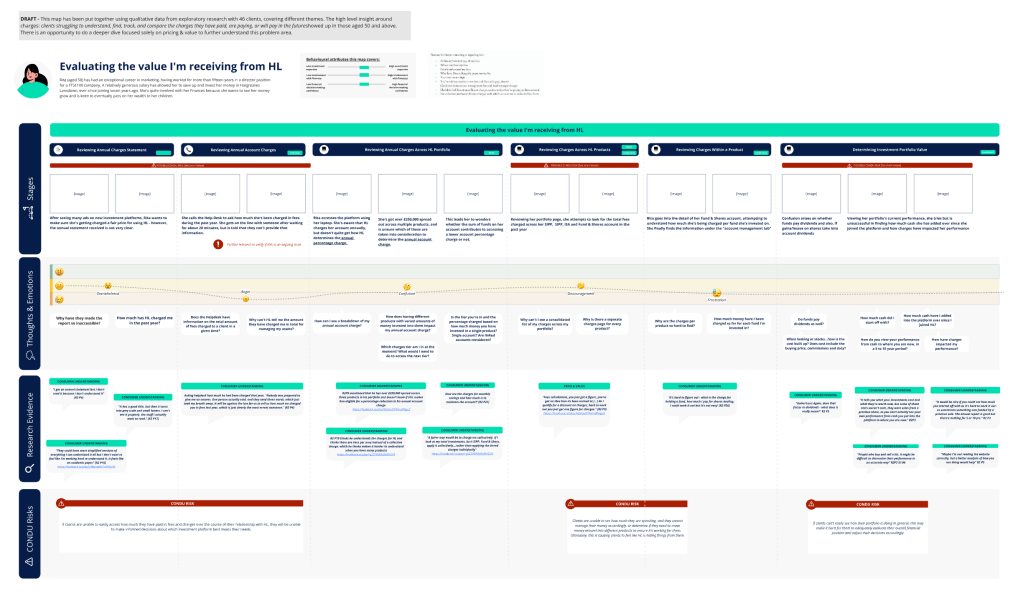
We developed a journey mapping guide and template, and ran support sessions with product teams. These maps were designed to highlight key pain points and be used alongside product frameworks.

Discovery Research:
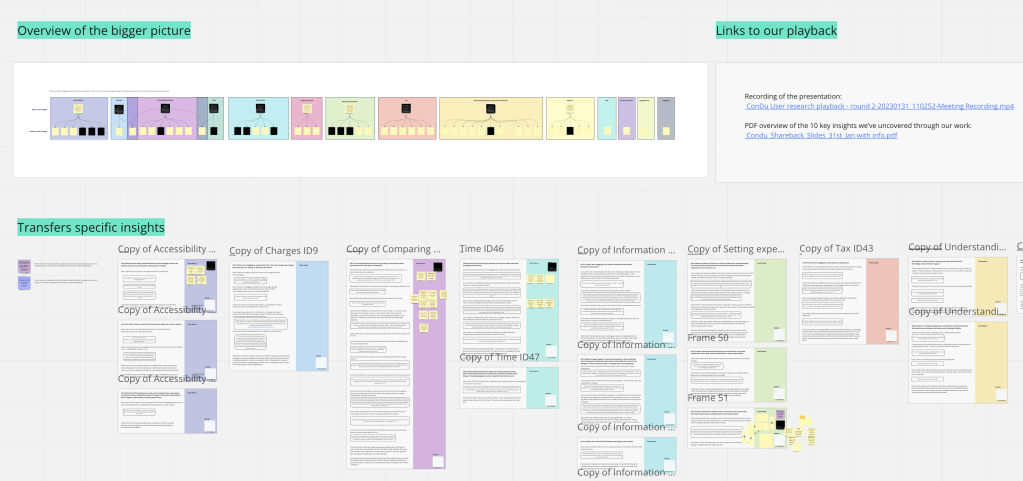
As a team, conducted 46 in-depth client interviews to uncover risks and unmet needs. This research produced 10 high-level and 52 product-specific insights, presented in actionable formats.
Workshops:
Facilitated 19 collaborative workshops with product, service teams, and working groups to share research findings, encourage team contributions, and drive meaningful change.
UCD Support for Priority Issues:
- Factsheets Discovery & Re-design: Collaborated with the Trading team to initiate discovery work after identifying clients’ difficulties understanding investment factsheets.
- Pricing, Loyalty, and Value: Mapped the end-to-end client journey around pricing transparency and launched a client survey. Worked alongside the newly formed workstream to ensure alignment.
Future Resourcing Planning:
Created a prioritised list of upcoming Consumer Duty issues, estimated required effort (“T-shirt sizing”), and outlined needed roles to inform UCD resourcing.
Tools and Frameworks Developed:
- Consumer Duty & Client Outcomes breakdown
- Prioritisation framework for CD issues
- Research approach for vulnerable clients
- Client-centric heuristics
- End-to-end journey maps
Outcome
Our work surfaced critical client experience gaps and shaped how HL responds to Consumer Duty. Teams are now better equipped to identify and resolve issues through journey mapping, prioritisation frameworks, and research tools. Two strategic workstreams were initiated from our discoveries, and our tools continue to be used by the wider UCD team to embed client-centric thinking across HL.
Key Learnings
One of the biggest things we learnt during this project was the importance of being human-first. Human-first with our colleagues as well as the users. Instead of handing over issues we found during research, we instead worked alongside the relevant teams to understand what they already understood and any work they were already doing in their spaces to improve the lives of their clients. By working alongside the teams, it meant that we could offer extra assistance to those teams who had high priority consumer duty issues to address, but needed UCD resource. Working collaboratively always delivers the best results.
 Naomi Parker