The client offered a digital food tracker/planner that was underperforming in terms of user engagement and adoption. Meanwhile, competitor apps offering meal planning support were seeing notable success in the same market.
There was a clear opportunity to understand user behaviour around meal planning and to explore how the existing product could evolve to deliver greater value.
Design Challenge
To understand more about meal planning behaviour and to create a service which met the core needs of all types of planners
At the time the business had a nicely designed meal planner, available both on the website and within the app. Not only was it being underused, we were seeing a spike in users asking for a good meal planner and mentioning that they were instead using planning apps made elsewhere. We were losing traffic to other places who, on the surface, we offering a similar service.

My Role
- Framed the problem and led a small team in an 8 week discovery
- Explored the behavioural aspects of planning behaviours. Inspected the phycology of planning and types of human behaviours around this
- Explored how people approached meal planning and identify pain points, motivations, and unmet needs
- Identify opportunities to improve the planning experience in ways that align with user behaviour and expectations
- Generate evidence-based recommendations to inform a future product direction, aligned with GDS principles and leading into an Alpha phase
- Helped shape early ideation and communicated findings effectively through presentations and visuals
Approach
Understand
- Explored existing insights, market trends and tried out competitor planners
- Explored current user behaviours, barriers and motivations by running qualitative research sessions
- Inspected behaviours using video diaries to capture real-life planning activities and context over time
- Collected supporting data to validate qualitative insights
Making it visable
- Created early playbacks for stakeholders to help them see real people meal planning in their video diary entries
- Created archetypes explaining types of planning personalities and their varying needs
- Created journey maps to show behaviours over time

Designing the future
- Ran initial ideation sessions and collaboratively visualised high-level design ideas
- Delivered a compelling narrative of findings, including user personas, planning personalities, and future opportunity areas.
Outcomes
At the end of this project the business had a much better view on what was needed to create a successful, user-first meal planner. A planner which would help those who struggled to plan and organise food in advance, as well as those who found planning easy. We positioned the team for a smooth transition into a prototyping phase.
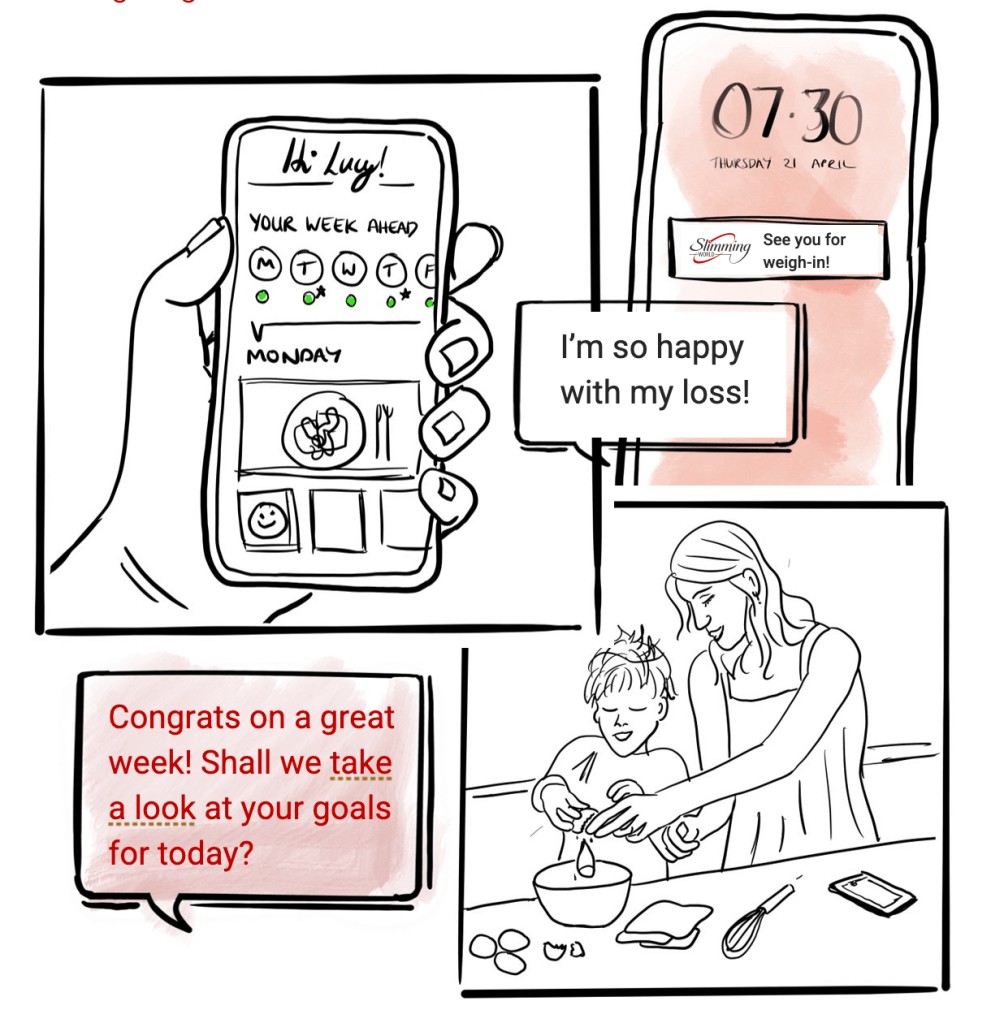
The development team went on to try out proof of concepts using push notifications which the user could set for a time most useful for them.
Key Learnings
One of the most interesting parts of this project was discovering the differences in different types of planning behaviour. There was a very obvious subset of users who had always, and may always, find planning of any type difficult. Learning that they wanted support, and wanted to be able to plan better for their week offered us a key insight into being user focussed.
On top of this, it opened up some interesting conversations about what type of planner we were with everyone on this project, from close colleagues to some of the directors.
 Naomi Parker